

Date Archives June 2026

American Dream in Modern Novels

This writing is mainly intended to reveal the aspects of the American dreams in modern novels. The stressed aspects are Pursuit of happiness, Persistence, Self-reliance, Individualistic, and the way to wealth. This piece of research is a qualitative one. This tries to describe the aspects of American dream through the sociological approach.

The American dream has long been an ideal of prosperity not just for Americans, but for the people all over the world. The promise of freedom and a better life drew hopeful immigrants before there was even a country to call home, and has continued to draw millions since then. Over time, the American dream has proved a resilient and unique concept that Americans have come to understand and define in different ways as relevant to their own narratives and experiences. These values and principles rooted in individualism, self-actualization, and self-reliance where people are able to fulfil their own destiny, be self-reliant, and believe in the promise that through hard work and perseverance life can be different and better than before.

1. INTRODUCTION

The novel has always been modern – always concerned mainly with contemporary life, and always after every new thing. It seemed to break the world in two, snapping all continuities with the past along with putting human character and life itself into a state of constant change. To keep up, the novel also had to snap and to split – to change. For this reason, it became “the modern novel,” breaking with the past, making itself new, to pursue modernity into the future.

The American dream can be examined and traced back to the ‘Declaration of Independence’ in 1776 where proclaimed people were entitled to “life, liberty, and the pursuit of happiness”. Pursuits that ended with people achieving some level of fulfilment through hard work, tenacity and perseverance. With that being said, the very term or phrase “The American Dream” did not truly receive some sort of formal definition until 1931. Amid the Great Depression, James Truslow Adams, in The Epic of America defined the term “dream” in concrete terms as a vehicle that promises and allows all its citizens, regardless of origin or social status or prosperity in a society founded on the basis of free and equal opportunity.

For example, the American dream is that if a person works hard, the probability of her or him being successful is quite high. In fact, this idea that working hard will always pay positively is not realistic because society is diverse where being successful or unsuccessful is affected by a number of factors some of which are not in control of anyone. As one of those movies that mostly reflect the idea of the American dream, The Pursuit of Happyness is taken as an example in this writing. In addition, this writing can let people understand the essence of the American dream and its influence on people all over the world. So, the study basically involves the rise of the American dream along with the reasons for its rise in this manner, an understanding of the plot and characters of a movie, a comprehensive view of the American dream and so on. The significance of the study is in a dialectical view of the American dream and a better understanding of the same.


2. THE MEANING OF THE AMERICAN DREAM AND ITS RISE

2.1. The meaning of the American dream

What is the American dream? The concept which is often mentioned must be examined thoroughly. In modern society, the narrow sense of the American dream is often understood as: As long as you work hard in any situation, no matter how difficult it becomes and don’t give up, then you will realize your personal value and have success.

The main point of this concept that makes it worth studying is that they rely on their own strength to struggle, rather than relying on the aid of others or on any particular social class. In the common sense, the American dream is the ideal of a democratic, equal and free country.

Sometimes, we see it as something that we want to achieve and we strongly believe in it that we can achieve. Like, the television show Leave it to Beaver where there is a bourgeois and nuclear family which reside comfortably in the countryside blessedly. This family reflect the dream of the American people which we are calling as the American dream. Not only that, but we can also see many more films certainly in support of the American dream. As The Pursuit of Happyness, this is a movie about persistence and effort. The meaning is that hard-working people’s dreams will eventually come true as long as they get through unremitting efforts and they can lead a good life.

The story of America is an exciting story to witness, filled with the evolution and amazing energy which is unprecedented in the known history of the world. The provocative reputation of America has been the celebrated ideal of the American dream along with the fantasy of complete independence and self-reliance mixed with opportunity to attain wealth through one’s labour. On the other hand, this case seems almost enchanted that is offering people the unprecedented, striking and revolutionary prospect of achieving success. The American dream is exactly what it appears to be – the opportunity of the ceaseless temptation of pleasure.


2.2. Exploring the vicissitudes of the American dream

The American dream that often seems like a fantasy is distorted and disillusioned by the great development of the capitalist industry. This could be explained under various headings.

2.2.1 Economic Reasons

In the early 20th century, due to the war which in a way also lead to the scientific and technological revolution in the contemporary American society, the American economy witnessed a growth in an unprecedented manner. Nevertheless, that growth did not sustain long and it was quickly followed by the great depression.

After the great depression, the American economy was much weaker than before. The gap between the rich and the poor in the contemporary American society was still widening at that time, and the distribution of social wealth was uneven. Like it always happens in such situations, Americans at the bottom of the society were greatly affected by the economic condition, some people even lost their jobs.

It certainly headed to many questions like – How to describe economic development? How to describe the American dream? At that point of time, it was difficult to answer the tough questions. So, at this point, the American dream began to unravel.


2.2.2 Historical Reasons

About a decade after the end of the first world war in 1918, the great depression of 1929 had not yet arrived. In mid 1920s, the traditional puritan morality had fallen apart and people’s hedonism began to spread. These people who have lived through life and death believing that life should be lived on time. It leaded the American dream, that everyone once believed in, to erode away.

So as Fitzgerald said:

“This is an age of wonder, an age of art, an age of extravagance, and age of mockery.”

The trauma of the history has made the people to appreciate the value of life more than the American dream and the fantasy of American dream which needed to be achieved through hard work has been gradually abandoned by the people.


2.2.3. Social Reasons

The realization of the American dream is the pursuit of a better life. The premise of the realization of the American dream is that everyone has an equal opportunity to do better with life.

They are judged on the basis of equality by people, when they are taking a job interview or they are applying for the university. They are not subjected to their financial situation and family background. If an opportunity is not equal, how can people believe that the American dream is real?


2.2.4. Small-Town Life

Just after the beginning of the twentieth century, one widely accepted the literary vision of the American dream involved life in a small, tightly knit community where residents were free from secrets and ill will. This idealized vision of a perfect American town, far removed from the tumult of the rest of the world, became a symbol for how the United States viewed itself in the larger community of the world.

America was a country that has really advanced in this current world. In various fields like economics, politics, social values, science as well as the American technology is more superior in comparison to other countries. Therefore, many countries in the world nicknamed America as the “superpower”.


According to Albert and William in their Luedtke book (1988:23) The American drew particular values, they are:

  • An activist approach to life that is based on mastery rather than passive acceptance of the events.
  • Emphasis on the achievement and success that is understood largely as material prosperity.
  • A moral character oriented to such puritan virtues as duty, industry and sobriety.
  • Religious faith.
  • Science and secular rationality encouraged by a view of the universe as orderly, knowable and benign and emphasizing an external rather than inward view of the world.
  • A progressive rather than traditionalist or static view of history which is governed by optimism and confidence in the future and a belief that progress can be achieved by the combined efforts of all.
  • Equality along with a horizontal or equalitarian view rather than a hierarchical view of the social relations.
  • High evaluation of individual personality rather than collective identity or responsibility.
  • Self-reliance, humanitarianism, external conformity, tolerance of diversity, efficiency and practicality rather than idealism.
  • Freedom, democracy, nationalism and patriotism, idealism and perfectionism.
  • Mobility and change.

In the case of the “American Dreams”, it emphasizes to the moral values of the American as the most important requirement. As per Ben Franklin – hopes lead to the success and virtues, wealth and virtues lead to the honour and virtues. Virtues appear to be the means to success, wealth, and honour. Although, the American society, as we know it today with all its problems and promises that is their true monuments.

According to Emersus in Roth Book (1976-83):

“All men plume themselves on the environment of the society, and no man improves, society never advances”.

His point is that the society, in and of itself never improves, neither itself nor the individuals of the society. A person has to do the job personally if any headway is to be seen as forth coming. Besides that “belief in the potential of the American life”, that was the bases for Emerson’s American dreams of self-reliant individual living as one.


Literature

Twentieth Century Interpretations of The Old Man and the Sea have assisted to explore the American Dream reflected in the ideology of the old man.


CONCERN OF FREEDOM OF SANTIAGO

Throughout the novel, The Old Man and the Sea, Santiago upholds the freedom for his existence. In fact, the reflection of the freedom, as evident in the life of Santiago and the essence of this freedom in the life of Santiago could be attributed to the virtues of the American Dream.

The genesis of this individual freedom goes with the crisis lying in the context of the novella that concerns a time when America was affected by the great depression caused by a downfall in American stock market in the year of 1929.

Hemingway presented before Santiago, the Freedom of choice which is the core of existentialism and it is evident in the uniqueness of individuality of Santiago. Day after day, he got up, pushed through, and kept fishing even when people told him he was not good enough.

“They sat on the terrace and many of the fishermen made fun of the old man Santiago and yet he was never angry.”

The fishermen teased him constantly and Santiago didn’t care. In fact, here, his choice of not to change or give up made the old man an individual. He chose to fish, to stay and to endure. He always had opportunities to walk away, however he stuck through the sweet agony.

He chose to kill a fish which was like his brother. He says:

“Fish, I love you and respect you very much but I will kill you dead before this day ends.”

This shows a lot about the mental strength of the old man Santiago.

The mental make-up of the old man is, as such, uniquely built that is facilitating him to go for the freedom of his individual existence. He, as a representative of existentialists, enjoys the freedom in taking decisions on his own.

Here, his decision does not follow the so-called trends of the society. He finds his uniqueness in individualism, takes the liberty, and himself bears the responsibilities for his actions.

He says:

“I am a strange old man”.

This statement of him is esteeming the natural uprightness in his decisions. Though old, his cheerful eyes yet look forward for decisions at his sweet will as is found in the statement of the writer:

“Everything about him was old except his eyes and they were of the same colour as the sea and were as cheerful and undefeated.”

It is Santiago who decides his mode of life because despite his great strength and abilities, he is living humbly. He lives in poverty, owning a small shack which has no running water, yet he never complains. He is, basically, keen on the freedom of taking his own decisions in face of the challenges of the humble life that he leads.


SANTIAGO’S DREAM OF BETTER LIFE

As galvanized with the essence of the American Dream, Santiago too dreams of a better life.

The philosophy of Santiago’s better life has its radix in the American Dream as it is inferred from the statement of James Truslow Adams who, in 1931, of the American Dream, says:

“…life should be better…for everyone, with opportunity for each according to ability or achievement… regardless of social class or circumstances of birth.”

In fact, Santiago’s struggle for his dream does not come to an end because the word, ‘better’, that is comparative in degree alludes to the comparison between the things he has achieved and things more desirable to him to be achieved.

That is why his effort for better life is dynamic, and as such, a continuous process that can end only with death.

Santiago’s dream for a better life counts upon his positive attitude and efforts irrespective of their being fruitful or abortive.

The better life Santiago dreams of is free from any sad feelings and full of sublimity. He always keeps himself aloof from mental ailments that bring about unhappiness. For Santiago, dream life is something which should have continuity along with dynamism.

Santiago’s philosophy and dream make him unconventional in his society as mentioned by various critics including Bickford Sylvester and many more. He is devoted to a profession that he esteems as a more spiritual and as a way of life and a part of nature’s order in the eternal cycle that makes all creatures brothers in their common condition or situations.

Come what may, Santiago, therefore, tackles his problems, failures and sorrows with his philosophical sublimities and struggle. In a nutshell, this is what American dream is all about.


SANTIAGO’S STRUGGLE TO ACHIEVE THE DREAM

In the novel, Santiago is characterized as someone struggling for turning his dream of prosperity and success into realization with an eye to causing upward social mobility for himself.

In the beginning of the novel, he, though facing barriers, is found dreaming of changing his future. Dream in his life, as a catalyst, regulates his everyday activities.

The cuts of his fingers bear testimony to his struggle to change his ill fate and to stand upright with honour and dignity. For him, life refers to the continuous struggle for existence and so he is still dreaming of finding a place in the adverse world by virtue of his enterprise.

He dreams of availing every opportunity, whenever and wherever possible, to lead a life deeming his right to better life as some people do in the contemporary American society.

In fact, struggle along with the essence of prosperity and success that is embedded in Santiago pushes him forward to take up to any dangerous course of action jeopardizing his life.

Patience is the basis of the struggle that Santiago is carrying on for gaining triumph over his fate. In fact, he has to undergo two kinds of struggles – one is internal while the other is external.

The internal struggle refers to his effort to keep himself unshaken in continuous failure. As the novel opens, we see Santiago struggling for eighty-four days failing constantly to catch even a single fish. He still has a previous record of such instance of struggling for eighty-seven days without catching any fish.

Patience is the basis of the struggle Santiago is carrying on for gaining triumph over his fate. In fact, he has to undergo two kinds of struggles – one is internal while the other is external.

The internal struggle refers to his effort to keep himself unshaken in continuous failure. The external struggle is what we see with Santiago while he is catching marlin and trying to bring it to shore.


SPIRIT OF SANTIAGO A YARDSTICK OF THE AMERICAN DREAM

Santiago’s vigorous efforts represent the American Dream the yardstick of which is indomitable spirit. In fact, a man can make effort but he cannot ascertain his success.

Santiago, fixing up a target, works ceaselessly and he remains indifferent to the result of his work. Though much old, Santiago bears every pain on the way to attaining his dream.

During his failure he finds no one standing by him and condoling his bad luck, still he keeps his dream radiant. This spirit induces him to undertake his adventures of sailing far for fishing for which other fishermen feel unnerved.

Because of this invincible spirit Santiago stands as a symbol of the American Dream. From his own words, while he is struggling to drive away the sharks, we can elicit the ideology of his life:

“…I will try as long as I have the oars and the short club and the tiller.”

Santiago’s spirit reflecting the American Dream is contained in his resolution of achieving rare glory. The old are commonly seen giving away their endeavours and hopes and being subdued in the face of adversity whereas Santiago sails again and again for catching big fish.

As far as he looks at deeper in the sea, he gets new hope for surviving flouting his dotage. Unlike other people who do not dare do anything to fight shy of failure, Santiago dares embark on enterprises whether he loses or gains.

The spirit of the American Dream alluding to the fact whatever the situation it may be, goal will be reached through challenges.

In the attitude of Santiago, American ingenuity and resilience are evident. He cannot be called a loser because facing new challenges he gains more strength and knowledge than the other fishermen do.

For his endless dream to survive into the natural world, he becomes able to read the signs of nature only because of his lifelong experience of the sea.

A Taoist Reading of “The Old Man and the Sea”, Eric Waggoner about Santiago’s spirit of the American Dream says:

“…Hemingway depicts Santiago as a spiritual traveller who wishes to remain in the…path of correctness and right action.”

There is nothing that can stop him to go where he wants to. Santiago shows no fear. He is not like the other fishermen who stay within the surrounding they know best.

The old man shows the grace of spirited personality throughout his three days’ adventures for catching rare kind of fish. He does not give up though tired.

Constraints do not matter to him at all and so he can say:

“…but I must have confidence and I must be worthy of the great DiMaggio who does all things perfectly, even with a bone spur in his heel”.


CONCLUSION

From 1900 to 2000, the notion of the American dream assumed more forms, affected more dreamers, and encountered more backlash than ever before.

In the twentieth century, Americans dreamed of the same things as their forebears’ things such as freedom, wealth, and meaning. It is hard to say whether twentieth-century Americans were any more or less successful achieving their wishes than the generations that came before them.

However, though success is seemingly the pivot of the American Dream, through the struggle of Santiago, it is proved to be true that it is the spirit in pursuit of goal – irrespective of success and failure – which is the basis of the American Dream.

Santiago, by his concern of freedom for and dream of better life, has upheld the dynamism of the American Dream while he, with a view to ensuring that expected life, has to undergo harsh course of struggle.

Santiago has, for his life, gone by a particular ‘code’ maintaining values which have not let him be distracted. The dream he has is certainly of success, yet the nucleus of the dream is his spirit preparing him composed.

Since success cannot be easily grunted, to ensure it, endurance and patience as apparent in Santiago are must.

That the novella starts with struggle and comes to an end with the same refers to the essence of the American Dream which is, as such, synonymous to a universal spirit that glares forever.

Santiago, therefore, believes in his ability instead of chance.

“To hell with luck,” he thinks. “I’ll bring the luck with me.”

The fact that writers return to the theme again and again with new aspects to explore and new perspectives to present tells readers that Americans continue dreaming the dream.
Post-colonial Literature

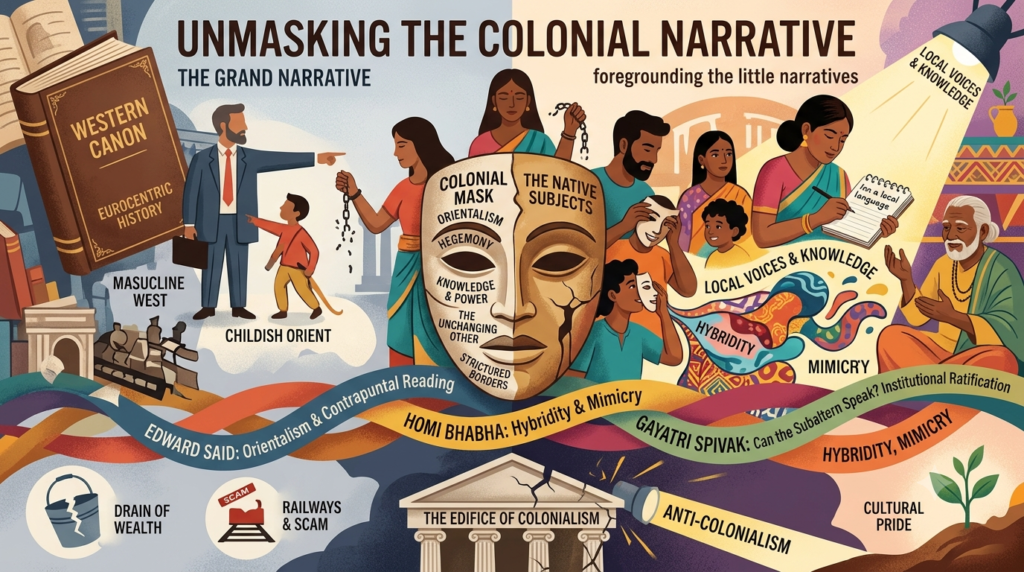
Abstract The fundamental reason of the post-colonial studies has been to undermine and delegitimize the grand narrative of the European colonialism which gained ascendancy, especially in nineteenth and early twentieth century. This is complemented by a sustained attempt by post-colonial scholars to foreground the little narratives of the people who were subjugated by colonialism, either politically or culturally or economically.

Key terms Colonialism, Native, Subjects, Knowledge and Power, Drain of Wealth, Heart of Darkness, The Minute on Education, The Exploitation of Subalterns, Orientalism, Hybridity, Mimicry, Hegemony

Introduction Post-colonial literature has a broad dimension with a large variety and different phases that begun as an academic interest right after the end of colonialism. The imperial power had their own system of education that were imposed upon the native subjects to continue their dominance effectively. In Gramsci’s words, there was a sort of hegemonic control of the colonizers over the native subjects. Along with that, there were a tight control and censor over the literary work to an extent that there were very few academic works that showed the real faces of the colonial experience. It was been hammered in the minds of the natives (including Indians) that British are civilizing and educating Indians.

Colonialism and Post-colonialism Colonialism is one of the latest trends with us and we are still facing a large number of problems that relates to the colonialism. Post colonialism is the period after the colonization ended during the second half of the twentieth century. It is related to the colonialism which was a political phenomenon. During eighteenth and nineteenth century, the European nations colonized the politically and militarily weaker countries of Africa, Asia and Latin America. This phenomenon of colonization affected all aspects of society including the education. Literature could not have remained unaffected by the power of colonialism as Michael Foucault in his knowledge power relation showed how power and knowledge drives and depends on each other.

Decolonisation began in 1918 after the end of World War I and continued all through the end of World War II in 1945. By 1950, most colonized countries get liberated. British left India in 1947. Now as we became independent, we have to defend ourselves by actively engaging with our destiny. In one sense we have left the chains of colonialism but in other sense by being in post colonialism we have entered in yet another phase of colonialism as there is a discussion whether it is post colonialism or just another phase of colonialism. We still live in the post-colonial time and the trends and phases of colonial and post-colonial history are there with us.

In Indian context, post-colonialism refers to a new phenomenon carried from the earlier features but became radically different. The new phenomenon of 1950 was a different India from the India before the second world war but at the same time, to some extent it remained the same India. Post colonialism in itself reflects that we are out of colonialism but is this a reality? How we know that we are out of colonialism? If we believe that the colonialism ended just because the imperial nation stopped the exercise of their power to directly dictate the policies for their subjects then we should ask ourselves that whether this necessarily changed the things on the ground in the post-colonial period. There are things that we would have wanted to discard like the casteism, section of society against each other, poverty, malnutrition, unfulfilled aspirations (especially of youth), the pity conditions of women, etc.

The policies that government adopted during the post-colonial period was not dictated by any other power but by our own democratic formation. This phenomenon of colonization and then decolonization have its own repercussions on our education, language, culture, art, etc.

The literature produced during the colonial period were heavily influenced by the culture and ideas of enlightenment and renaissance that was started in sixteenth century and completed by the eighteenth century just when the process of colonization began. These ideas of enlightenment were thrust upon us and we were made to feel that a great favour is being done to us by transforming us from a primitive society to a civilized nation. Our own civilization that is thousands of years old is being supressed. We were made to believe that our rich civilization was not even a civilization rather it was just primitivism and there was a complete absence of culture and civilization and therefore we must learn what they have to give us.

Post-colonial Literature When we speak of post-colonial literature and post-colonial criticism, we talk about the period of both the colonialism and its effect after the colonialism was over. In India post-colonial period began after 1947. The post-colonial text also include the texts of anti-colonial and it is based on radical criticism of colonizers. Then there are other literary works that come under post-colonial literature that emphasize on our local problems and its reasons and solutions. This was started even in the British rule. There were writers who were writing texts that gave the true picture of what India was like before the arrival of the colonial powers and how distortions have come about in our life, culture, economy, society, education and literature because of the foreign rule. The “Drain of Wealth” theory given by Dadabhai Naoroji in 1867. The writings of Rabindra Nath Tagore in the nineteenth and early twentieth century is full of nationalist songs criticizing the British imperialism. Bankim Chandra Chatterjee also wrote many nationalist songs in the presence of the British rule. This shows that we had a thrust of post-colonial thought in our literature even during the British rule over India.

There is a long history of politics and of literature being inspired by politics. What we call post-colonial literature is the literature inspired by the politics of anti-colonialism. The post-colonial literature has very strong political overtone and political content. The very essence of post-colonial literature is anti-colonial and nationalist. To understand the post-colonial literature, we must know about the colonialism and its reality. The basis of colonialism was not so much political or strategic/military as it was economic. The colonizers wanted to exploit the resources and potentials of the weaker countries. The liberal classical British economists like Adam Smith in his book “Wealth of Nation” and David Ricardo in the eighteenth century highlighted the need for colonialism and its economic uses in fuelling the industrial revolution. Their thesis was that the processes of imperialism and colonialism was not so much rooted in politics as much it was rooted in economics.

The literature produced by the European writers, poets, scholars and others during the colonial era were full of racism and distortions with a clear and open tilt towards European superiority and the native inferiority. Joseph Conrad, an English writer written a novel in 1899 called “Heart of Darkness” in which he describes Congo in Africa as the heart of darkness by painting a negative picture of local customs and traditions of Congo. Similarly, when E.M. Foster wanted to write his experience of living in India and comprehending India in the form of a novel named “A Passage to India” in 1924, all he wrote was limited to his views and understanding of India. He did not see the reality because of his lens of superiority.

After the British left or even before that there were many anti-colonial and post-colonial texts started coming both as a reply to the British texts and also as original scholarly works on post-colonial thinking and theories. Though anti-colonial also come under the larger canvas of post-colonial literature but there is a difference between these two terms. Anti-colonial is outrightly oppose to colonialism whereas post-colonial texts are historically placed texts that came after the colonial rule was over. Anti-colonial texts are covertly against the colonial power whereas post-colonial literature is the one that follows when the era of hard colonialism is over.

Post-colonial literature is reinterpreting and criticizing the colonial literature, colonial policies, rules, acts, laws, etc. It is looking back and reinterpreting the colonial writings that what the Britishers have told the world about their imperialism and what is the actual reality from the perspective of the natives. The post-colonial literature has an important place of its own in the education system because of its richness and relevance. They act as the source to debunk the false narrative set by the colonial masters.

After the post-colonial period begun, there were sharp changes that could be observed in economic, political, social, legal and linguistic structure of the country. There were changes at economic level because of the adoption of the socialist policy of economic growth. In the field of law, there were many progressive laws were formed including the Hindu Code Bill. Cultural pride started to reflect itself. A series of philosophical and social debates started the churning of local problems towards solution-oriented conclusions. All these aspects of the post-colonial features were captured in the post-colonial literature.

Indian languages were quite influential during the pre-British colonialism. English as a vehicle of literary expression was not very powerful during pre-British India. Other languages such as Bengali, Marathi, Tamil, Gujarati and other regional Indian languages were literally much stronger than English. There is the historical ambivalence which expresses itself in a completely different attitude which surfaced in the East India Company early in the nineteenth century under the supervisorship of Charles Grant. He firmly implanted the imposition of Englishness on the colonized other to be the agenda of colonization. The famous historians Thomas Babington Macaulay codified this attitude in “The Minute on Education” which insisted that the education of the Indian people under the regime of the East India Company be conducted strictly according to English models.

Knowledge as in fields of politics, economics, laws, technology, education started flourishing in the post-colonial period. Women started getting education in much larger number. When literature is being discussed and written in the 1950s and 1960s, women writers and scholars were coming forward who use to talk about their problems and also about their aspirations and demanded the opportunities to be at par with the men.

A number of books, magazines, newspapers and other literary sources were exponentially increased during post-colonial India. Around 1970s and hence after, English emerges as a very strong and powerful medium of literary source. In 1950s and 1960s, due to the spread of education among the general public and also due to the enormous aspirations in the people, the number of middle-class people rose in large proportion. The spread of education is a very important factor that influenced many aspects of the society that also influenced the post-colonial literature to a great extent.

The impact of colonialism on our literature The colonial experience of the native has impacted almost every aspect of their life including literature. Mulk Raj Anand wrote “Coolie” in 1936 which depicts the period of 1930s colonial India and shows how the life of poor were conditioned, compressed and repressed by the dominant powers be it the imperial or the local. Many writings of Munshi Premchand also shows the poor and conditioned life of subalterns during the British rule of India.

If we go back in history, in any society or community, free or bonded, colonised or not colonised, we will find that since ancient times, there has been a standard practice of the rich and privilege exploiting the poor. All those groups of people who get any opportunity to exploit others for their own benefit did the same that to some extent may vary in degree but not in intention. This points to the human nature that there is something in our nature that we want to dominate and exploit others for our own advantage. This aspect of human nature is also discussed in the post-colonial literature.

Literature is not merely history. There is a difference between them. The history is strictly bound by time and place, by local and immediate conditions, whereas literature is not bound by any condition. Literature may have its own circle of existence as it too relates to a reality but at the same time the writer looks beyond reality and try to reconstruct that reality in different manners. The man of letters does not confine themselves to history. Literature is called universal unlike history that is bound by time and space. Literature (like the post-colonial literature) even if it starts at a particular time period in history, it does not stop there. It gives a larger dimension and a larger perspective to that time period of history. Literature has a larger relevance. It is applied outside a particular reality. Post-colonial literature has a link with the colonial period that is different from other literature which has no sign of any form of colonial experience.

Post-colonial Studies What derives coloniality? Is it always nationalism or is it transnational interests? Is the relationship between the colonist and the colonized a relation of some sort of metropolitan nation with respect to the provincial empire or is it a relation which is dictated and generated by the economic interests? This is a complex subject that generates a great deal of debate in the field of post-colonial literature.

Edward Said: “Orientalism – Western Conception of the Orient” (1978)

Edward Said explored how the European colonialism of the Orient or the East was not simply a matter of military subjugation or occupation. It also involved the creation and the proliferation of a discourse that legitimized the colonial subjugation of the East by the West. It is this discourse and the ways in which it gets generated and circulated that Edward Said refers to as Orientalism.

According to Said, the Western tradition of thinking about the Orient as a single entity with a homogeneous characteristic feature can be traced back to Greek literature where we find that the Orient is being depicted not just as a landmass but as “Other” to the European self. The Orient is presented as the exact opposite of all the qualities which the West consciously cultivates as part of its cultural self-fashioning. If the West considers itself to be characterized by a culture of masculinity, then the Orient, by contrast, assumes a feminine entity. If the Occident likes to think itself in terms of mature adulthood, then the Orient becomes for them a representative of childish immaturity. If the Occident consider themselves to be at the pinnacle of civilization, then the Orient comes to represent the depts of Barbarism, moral and cultural depravity.

This peculiar way thought about Orient gained a significance prominence during European colonialism and provided a template for forming and leading a discourse about the subjugation of the East by the West. Later, Orientalism emerged as an academic discipline which was built upon the old Western prejudices about the Orient.

Napoleon in his invasion on Egypt in 1798 accompanied an army of scholars and scientists who would transform the occupied territory in a field of academic inquiry and systematic knowledge gathering. This led to the production of a multi-volume Encyclopaedia of Egypt called “Description de l’Égypte”. It describes the geography, history, flora and fauna, the people of Egypt through western perspective underlined by millennia-old prejudices Occident towards Orient. Such “scientific knowledge gathering” about the subjugated territory and its people can be observed as a major characteristic feature in almost all European colonialism.

In the context of British colonialism of India, Warren Hastings, the first Governor-General of British India, colonial officers like William Jones, Henry Thomas, Nathaniel Halhed and others during the late eighteenth and early nineteenth century researched and compiled volumes of knowledge about India. They published papers and monographs on subjects of Indian law, literature, astrology, flora and fauna, history, etc. The product of such systematic knowledge gathering about the subjugated population in the form of various academic publications generated a full-fledged discipline known as Indology. The works of the European on the Orient very soon came to represent the most authentic knowledge about the East. According to James Mill, British colonial historian, everything about India that is to be known is already available in the form of academic publications. Such knowledge gathering about the Orient deeply influenced how the Orient was governed by the colonial authority.

Subjugation is exercised not just through brute force but also through institutions, through which power is wielded indirectly. The cluster of institutions through which the Orient was controlled systematically is what referred to by Edward Said as the corporate institution of Orientalism. The way this corporate institution functioned and wielded its administrative power was heavily determined by the biased view of the East by the West, which by the late eighteenth and early nineteenth century had come to be translated into respectable form of academic knowledge.

The discourse about the Orient, underlined by the age-old prejudices of the Occident and ratified by their colonial institutions also deeply influenced the way Orient was being conceptualized and written about in Western literature by celebrated authors like Lord Byron, Gerard de Nerval, Gustave Flaubert, Rudyard Kipling and Joseph Conrad.

Edward Said through his writings offered an insight into how the discourse that framed the works of the colonial authors within the field of literature was characterized not only by a deep association with the process of colonial subjugation, but also with the old Occidental bias about the Orient. Said main purpose was not simply to reveal the connection between literature and colonial discourse but also to undermine it by revealing its internal fault lines. For this purpose, Said developed a technique which is called the technique of contrapuntal reading. Contrapuntal reading is a reading strategy which tries to read a text underscored by colonial discourse like Orientalism by questioning some of its inherent assumptions which its authors and its intended readers would have shared as axiomatic. A contrapuntal reading of a nineteenth century British novel set in the Orient would proceed by undermining the basic assumptions that the West is civilizationally superior to the East or the Occident is more masculine or mature than the Orient.

Said Orientalism works in the historical moment of structuralism. Its primary concern is with the binary opposition, a mutual and interdependent binary opposition of central self and decentralized other including the way in which the construction of the otherness of the other is actually covertly also at the same time a means of constructing defining and delimiting the nature of selfhood or being western.

Bhabha takes with respect to the binarism of structuralism, a deconstructive attitude. His sense of these relations breaks down into a redoubling sense of “double consciousness” so that one cannot clearly identify the colonizer and colonized as a binary opposition.

Homi Bhabha: “Location of Culture” (1994) Homi Bhabha’s intervention in the field of post-colonial theory is marked by his conceptualization of a non-essentialist theory of culture which undermines the colonial grand narrative and provides a lens through which we can identify the dynamics of alternative counter narratives. The major ideas of Homi Bhabha are – the hybridity and the mimicry.

Homi Bhabha in his book “Location of Culture” published in 1994 presents his two crucial concepts of hybridity and mimicry. The notion of hybridity is pivoted on a non-essentialist understanding of culture. Culture is not looked upon as a static entity that remain unchanged irrespective of the context rather culture is understood through the metaphor of a melting pot where desperate elements come together to form a whole. The whole is not a final form but subject to change and flux. As new elements get incorporated withing the melting pot, it keeps on getting integrated within the melting pot and the flavour of the cultural whole also goes on changing. This is what Bhabha signifies through his concept of hybridity or the notion of cultural hybridity. Culture is regarded as both spatially and temporally fluid and hybridity understands the cultural landscape as a site of constant intermixing of new and disparate elements.

The superior West which represents the colonial self and an inferior Orient which represents the other, cannot operate without assuming culture as static, fixed and unchangeable. Once the idea of culture as an isolated essence is challenged, the entire edifice of colonialism as a civilizing mission comes crashing down.

The concept of mimicry presents an account of how the colonized subject punctures the hegemony of the colonial discourse and asserts his or her identity, that is “menacing” to the edifice of colonialism. If a colonial discourse presence the act of colonisation as a civilizing mission, then it automatically expects the colonized subject to perform the role of imitators because it argues that it is only by trying to become like the colonizer that the colonized subject would emerge from his state of barbarity. Mimicry is not simply imitation. Mimicry also conveys the added nuance of ridiculing the person who is being imitated. Bhabha points out that the very act of the inferior colonized imitating the superior coloniser turns the latter into a subject of ridicule. The adoption of colonizer’s speech, mannerism etc. by the colonized subject turns his act into mockery of the superior colonizer’s culture.

Gayatri Chakravorty Spivak: “Can the Subaltern Speak” (1985) Within post-colonial studies especially among those who represent the various colonized interests of the world, there is a question specifically raised by Gayatri Spivak How the subaltern should speak? It means – which language should the subaltern speak in? Can the subaltern speak at all? Even Edward Said raises the same question in his analysis.

Gayatri Spivak’s essay titled “Can the Subaltern Speak” published in 1985 in a journal called Wedge. The term “subaltern” famously used by the Italian thinker Gramsci to describe a section of people who were subordinate to the hegemonic groups. According to Ranjit Guha, within the colonial context, the social elite is constituted not only by the European colonizers but also of the dominant indigenous groups who have access to hegemony. The subalterns represent the rest of the population which unlike the elite do not have political or economic agency. Subaltern is not defined as any specific social class rather it is defined as a negative social space with no sense of any distinctive identity. It is a position of absolute social disempowerment.

Spivak argues that the position of subaltern is such from where speech itself is not possible. So, the answer to the question in the title of her essay that – Can the subaltern speak – is that no, the subaltern cannot speak. They are not in the position to speak. Subaltern is not dumb and speechless in any physical sense rather they are the one who cannot generate discourse. The reason for this is that there is a certain important factor that regulate if an utterance is to be considered meaningful or not. One of the most important conditions which regulate this is “institutional ratification”. Any utterance not ratified by institutions like schools, colleges, publishing industry, news agency, learned societies are not regarded as discourse. These are precisely the institutions through which the dominant class assert their control over the society. The subaltern by definition does not have any agency within the society and it cannot generate a discourse because their speech does not receive the institutional ratification.

Shashi Tharoor: “An Era of Darkness – The British Empire in India” (2016) India was a country which in 1700 accounted for 27 percent of global GDP that made it the richest country in the world. The revenue of Mughal Emperor was more than the revenue of all the empires of Europe combined. India was a thriving civilization and the world’s leading exporter of goods since the time of Roman Empires. The accounts of sixteenth to eighteenth century from British shopkeepers trying to show the European clothes as made in India because of its mark of global quality. The technological advancement in metallurgy, ship building, etc.

The 200 years of loot, repine and plunder by the British reduced India to a poster child for third-world poverty. When the British left India, more than 90 percent Indians were below the poverty line. More than thirty-five million Indians have died in British created and administered famines. The zamindari system and the land revenue model introduced by the British created onerous burden on the Indian peasantry that created large a section of landless peasants for the first time in recorded Indian history. There were a series of painful experiences all through the British colonial period including the massacre of Jallianwala Bagh.

There is a mention of Railways, Rule of Law, Democracy, Judicial System, English Language, Tea and Cricket as the gift of British colonial rule that has been debunked by arguing that none of these was a gift rather every single case without exception was put in India with a single motive of enhancing British control, extend British power and to multiply British profits.

The British building the railways were a gigantic colonial scam. Railways were brought in for two purposes that is, to extract resources from the interior of the country and take them to the ports to ship to England. Secondly, to able to send troops into the interior to quell any unrest or disturbance. The railways were built entirely by the Indian tax-payers money and the profits went entirely to the British investors. Investing in Indian Railway was the single most profitable investment available in London during mid nineteenth century because it had a guaranteed rate of return. It was such a big scam that each mile of railway built in India cost nine times the cost it would have been built in Australia or United States of America. Even after the railway became functional, it run as a totally racist enterprise.

The Rule of Law was administered with excessive attention to the skin colour of the defendant. British even rationalized the oppressions by the whiten on native Indians by rule of law. In the entire 200 years of British rule in India there is only eight cases of British convicted for killing Indians. This shows the establishment of Rule of Law under British rule in India.

Criticism of Post-colonial Literature The post-colonial literature rejects the universalising claims of Eurocentrism. However, it uses the very same tools as the coloniser intended of deconstructing and questioning the colonial presumptions. While the post-colonial school focuses on the local, it tries to universalise the local, thereby falling prey to the same universalising tendency of colonialism. It changes the content but not the terms of engagement or the framework of the discussion.

Conclusions The colonial studies must be comprised of all the possible dimensions along with its criticism. The post-colonial literature is not just confined to describing, analysing and criticising the imperial exploitation of the people of the East but it also talks about the similar kind of exploitation on our people by our fellow Indians. For example, Historians like Ram Chandra Guha and scholars like Partha Chatterjee have written extensively about the practice of exploitation of subalterns. All these aspects are covered under the blanket of post-colonial literature. Be it poetry, fiction, novel or drama – in all forms we find the emphasis and exposure of colonial exploitation. This all come under the shadow of post-colonial literature. It has become a discipline in it.