In the past, “Heritage” and “Artificial Intelligence” felt like two ends of a spectrum. One was rooted in the dusty corridors of museums and ancient ruins, while the other lived in the sterile, high-speed world of silicon chips and algorithms. However, we are currently witnessing a Digital Renaissance where these two worlds are merging to save our collective past.
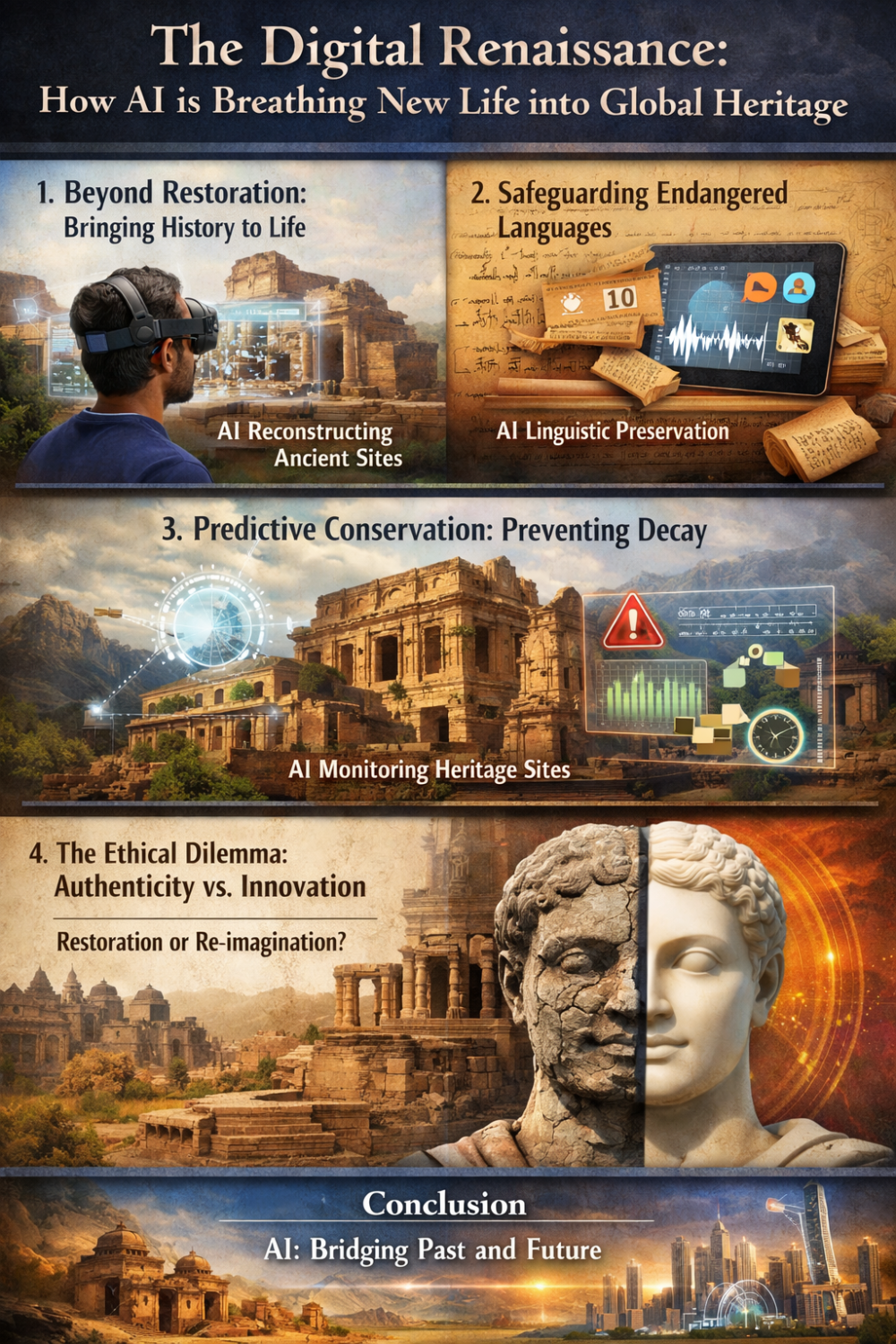
1. Beyond Restoration: Bringing History to Life
We’ve moved past simple photo enhancement. Today, AI models are being used to reconstruct lost monuments. Using Generative Adversarial Networks (GANs), researchers can analyze fragments of broken sculptures or faded murals to predict—with startling accuracy—how they originally looked.
Imagine walking through a 3D-reconstructed Nalanda University or the Library of Alexandria through an AR headset, powered by historical data points processed by AI. It’s no longer just “learning” history; it’s “experiencing” it.
2. Safeguarding Endangered Languages
Culture isn’t just stone and mortar; it’s the way we speak. Hundreds of indigenous languages are at risk of extinction. AI is now being used as a linguistic “time capsule.”
- Natural Language Processing (NLP) tools are being trained on rare dialects to create digital archives.
- These tools help translate ancient scripts that have remained undeciphered for centuries, potentially rewriting chapters of human history we thought were lost.
3. Predictive Conservation: Preventing Decay
Heritage sites are constantly under threat from climate change and urban decay. AI-driven Predictive Modeling allows conservationists to monitor structural changes in real-time. By analyzing satellite imagery and sensor data, AI can predict which part of a temple or a castle is likely to collapse years before it actually happens, allowing for preventive “surgery” on the structure.
4. The Ethical Dilemma: Authenticity vs. Innovation
If an AI “completes” a broken statue, is it still an authentic piece of history? The line between restoration and re-imagination is thinning. As we integrate AI into heritage, the challenge lies in ensuring that the technology respects the cultural soul of the artifact without “colonizing” it with modern biases.
Conclusion
AI is not a threat to our heritage; it is its new guardian. By bridging the gap between the 12th century and the 21st, we are ensuring that the wisdom of our ancestors isn’t just preserved in books, but is alive, interactive, and relevant for the generations to come.