
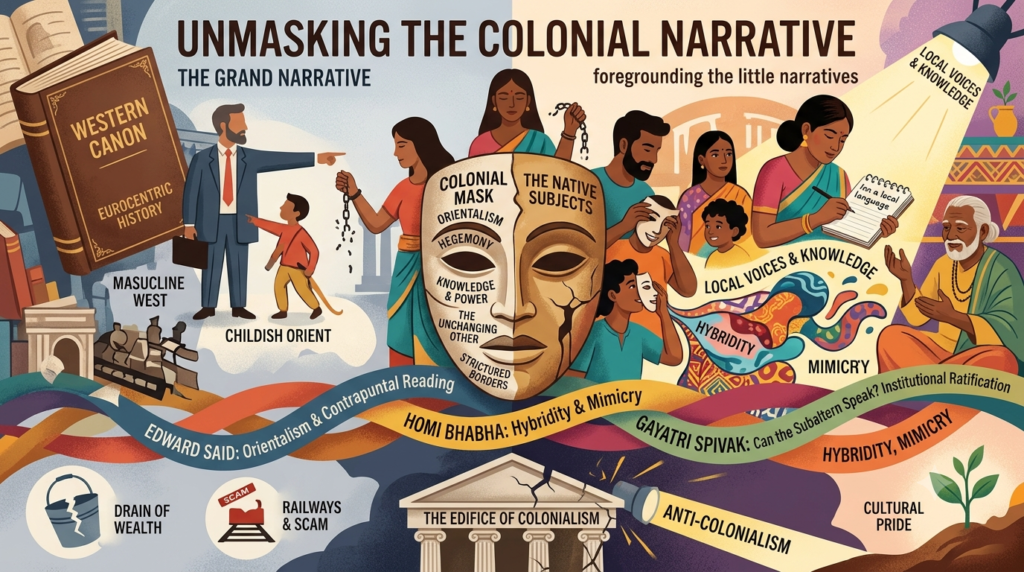
Abstract The fundamental reason of the post-colonial studies has been to undermine and delegitimize the grand narrative of the European colonialism which gained ascendancy, especially in nineteenth and early twentieth century. This is complemented by a sustained attempt by post-colonial scholars to foreground the little narratives of the people who were subjugated by colonialism, either politically or culturally or economically.
Key terms Colonialism, Native, Subjects, Knowledge and Power, Drain of Wealth, Heart of Darkness, The Minute on Education, The Exploitation of Subalterns, Orientalism, Hybridity, Mimicry, Hegemony
Introduction Post-colonial literature has a broad dimension with a large variety and different phases that begun as an academic interest right after the end of colonialism. The imperial power had their own system of education that were imposed upon the native subjects to continue their dominance effectively. In Gramsci’s words, there was a sort of hegemonic control of the colonizers over the native subjects. Along with that, there were a tight control and censor over the literary work to an extent that there were very few academic works that showed the real faces of the colonial experience. It was been hammered in the minds of the natives (including Indians) that British are civilizing and educating Indians.
Colonialism and Post-colonialism Colonialism is one of the latest trends with us and we are still facing a large number of problems that relates to the colonialism. Post colonialism is the period after the colonization ended during the second half of the twentieth century. It is related to the colonialism which was a political phenomenon. During eighteenth and nineteenth century, the European nations colonized the politically and militarily weaker countries of Africa, Asia and Latin America. This phenomenon of colonization affected all aspects of society including the education. Literature could not have remained unaffected by the power of colonialism as Michael Foucault in his knowledge power relation showed how power and knowledge drives and depends on each other.
Decolonisation began in 1918 after the end of World War I and continued all through the end of World War II in 1945. By 1950, most colonized countries get liberated. British left India in 1947. Now as we became independent, we have to defend ourselves by actively engaging with our destiny. In one sense we have left the chains of colonialism but in other sense by being in post colonialism we have entered in yet another phase of colonialism as there is a discussion whether it is post colonialism or just another phase of colonialism. We still live in the post-colonial time and the trends and phases of colonial and post-colonial history are there with us.
In Indian context, post-colonialism refers to a new phenomenon carried from the earlier features but became radically different. The new phenomenon of 1950 was a different India from the India before the second world war but at the same time, to some extent it remained the same India. Post colonialism in itself reflects that we are out of colonialism but is this a reality? How we know that we are out of colonialism? If we believe that the colonialism ended just because the imperial nation stopped the exercise of their power to directly dictate the policies for their subjects then we should ask ourselves that whether this necessarily changed the things on the ground in the post-colonial period. There are things that we would have wanted to discard like the casteism, section of society against each other, poverty, malnutrition, unfulfilled aspirations (especially of youth), the pity conditions of women, etc.
The policies that government adopted during the post-colonial period was not dictated by any other power but by our own democratic formation. This phenomenon of colonization and then decolonization have its own repercussions on our education, language, culture, art, etc.
The literature produced during the colonial period were heavily influenced by the culture and ideas of enlightenment and renaissance that was started in sixteenth century and completed by the eighteenth century just when the process of colonization began. These ideas of enlightenment were thrust upon us and we were made to feel that a great favour is being done to us by transforming us from a primitive society to a civilized nation. Our own civilization that is thousands of years old is being supressed. We were made to believe that our rich civilization was not even a civilization rather it was just primitivism and there was a complete absence of culture and civilization and therefore we must learn what they have to give us.
Post-colonial Literature When we speak of post-colonial literature and post-colonial criticism, we talk about the period of both the colonialism and its effect after the colonialism was over. In India post-colonial period began after 1947. The post-colonial text also include the texts of anti-colonial and it is based on radical criticism of colonizers. Then there are other literary works that come under post-colonial literature that emphasize on our local problems and its reasons and solutions. This was started even in the British rule. There were writers who were writing texts that gave the true picture of what India was like before the arrival of the colonial powers and how distortions have come about in our life, culture, economy, society, education and literature because of the foreign rule. The “Drain of Wealth” theory given by Dadabhai Naoroji in 1867. The writings of Rabindra Nath Tagore in the nineteenth and early twentieth century is full of nationalist songs criticizing the British imperialism. Bankim Chandra Chatterjee also wrote many nationalist songs in the presence of the British rule. This shows that we had a thrust of post-colonial thought in our literature even during the British rule over India.
There is a long history of politics and of literature being inspired by politics. What we call post-colonial literature is the literature inspired by the politics of anti-colonialism. The post-colonial literature has very strong political overtone and political content. The very essence of post-colonial literature is anti-colonial and nationalist. To understand the post-colonial literature, we must know about the colonialism and its reality. The basis of colonialism was not so much political or strategic/military as it was economic. The colonizers wanted to exploit the resources and potentials of the weaker countries. The liberal classical British economists like Adam Smith in his book “Wealth of Nation” and David Ricardo in the eighteenth century highlighted the need for colonialism and its economic uses in fuelling the industrial revolution. Their thesis was that the processes of imperialism and colonialism was not so much rooted in politics as much it was rooted in economics.
The literature produced by the European writers, poets, scholars and others during the colonial era were full of racism and distortions with a clear and open tilt towards European superiority and the native inferiority. Joseph Conrad, an English writer written a novel in 1899 called “Heart of Darkness” in which he describes Congo in Africa as the heart of darkness by painting a negative picture of local customs and traditions of Congo. Similarly, when E.M. Foster wanted to write his experience of living in India and comprehending India in the form of a novel named “A Passage to India” in 1924, all he wrote was limited to his views and understanding of India. He did not see the reality because of his lens of superiority.
After the British left or even before that there were many anti-colonial and post-colonial texts started coming both as a reply to the British texts and also as original scholarly works on post-colonial thinking and theories. Though anti-colonial also come under the larger canvas of post-colonial literature but there is a difference between these two terms. Anti-colonial is outrightly oppose to colonialism whereas post-colonial texts are historically placed texts that came after the colonial rule was over. Anti-colonial texts are covertly against the colonial power whereas post-colonial literature is the one that follows when the era of hard colonialism is over.
Post-colonial literature is reinterpreting and criticizing the colonial literature, colonial policies, rules, acts, laws, etc. It is looking back and reinterpreting the colonial writings that what the Britishers have told the world about their imperialism and what is the actual reality from the perspective of the natives. The post-colonial literature has an important place of its own in the education system because of its richness and relevance. They act as the source to debunk the false narrative set by the colonial masters.
After the post-colonial period begun, there were sharp changes that could be observed in economic, political, social, legal and linguistic structure of the country. There were changes at economic level because of the adoption of the socialist policy of economic growth. In the field of law, there were many progressive laws were formed including the Hindu Code Bill. Cultural pride started to reflect itself. A series of philosophical and social debates started the churning of local problems towards solution-oriented conclusions. All these aspects of the post-colonial features were captured in the post-colonial literature.
Indian languages were quite influential during the pre-British colonialism. English as a vehicle of literary expression was not very powerful during pre-British India. Other languages such as Bengali, Marathi, Tamil, Gujarati and other regional Indian languages were literally much stronger than English. There is the historical ambivalence which expresses itself in a completely different attitude which surfaced in the East India Company early in the nineteenth century under the supervisorship of Charles Grant. He firmly implanted the imposition of Englishness on the colonized other to be the agenda of colonization. The famous historians Thomas Babington Macaulay codified this attitude in “The Minute on Education” which insisted that the education of the Indian people under the regime of the East India Company be conducted strictly according to English models.
Knowledge as in fields of politics, economics, laws, technology, education started flourishing in the post-colonial period. Women started getting education in much larger number. When literature is being discussed and written in the 1950s and 1960s, women writers and scholars were coming forward who use to talk about their problems and also about their aspirations and demanded the opportunities to be at par with the men.
A number of books, magazines, newspapers and other literary sources were exponentially increased during post-colonial India. Around 1970s and hence after, English emerges as a very strong and powerful medium of literary source. In 1950s and 1960s, due to the spread of education among the general public and also due to the enormous aspirations in the people, the number of middle-class people rose in large proportion. The spread of education is a very important factor that influenced many aspects of the society that also influenced the post-colonial literature to a great extent.
The impact of colonialism on our literature The colonial experience of the native has impacted almost every aspect of their life including literature. Mulk Raj Anand wrote “Coolie” in 1936 which depicts the period of 1930s colonial India and shows how the life of poor were conditioned, compressed and repressed by the dominant powers be it the imperial or the local. Many writings of Munshi Premchand also shows the poor and conditioned life of subalterns during the British rule of India.
If we go back in history, in any society or community, free or bonded, colonised or not colonised, we will find that since ancient times, there has been a standard practice of the rich and privilege exploiting the poor. All those groups of people who get any opportunity to exploit others for their own benefit did the same that to some extent may vary in degree but not in intention. This points to the human nature that there is something in our nature that we want to dominate and exploit others for our own advantage. This aspect of human nature is also discussed in the post-colonial literature.
Literature is not merely history. There is a difference between them. The history is strictly bound by time and place, by local and immediate conditions, whereas literature is not bound by any condition. Literature may have its own circle of existence as it too relates to a reality but at the same time the writer looks beyond reality and try to reconstruct that reality in different manners. The man of letters does not confine themselves to history. Literature is called universal unlike history that is bound by time and space. Literature (like the post-colonial literature) even if it starts at a particular time period in history, it does not stop there. It gives a larger dimension and a larger perspective to that time period of history. Literature has a larger relevance. It is applied outside a particular reality. Post-colonial literature has a link with the colonial period that is different from other literature which has no sign of any form of colonial experience.
Post-colonial Studies What derives coloniality? Is it always nationalism or is it transnational interests? Is the relationship between the colonist and the colonized a relation of some sort of metropolitan nation with respect to the provincial empire or is it a relation which is dictated and generated by the economic interests? This is a complex subject that generates a great deal of debate in the field of post-colonial literature.
Edward Said: “Orientalism – Western Conception of the Orient” (1978) —
Edward Said explored how the European colonialism of the Orient or the East was not simply a matter of military subjugation or occupation. It also involved the creation and the proliferation of a discourse that legitimized the colonial subjugation of the East by the West. It is this discourse and the ways in which it gets generated and circulated that Edward Said refers to as Orientalism.
According to Said, the Western tradition of thinking about the Orient as a single entity with a homogeneous characteristic feature can be traced back to Greek literature where we find that the Orient is being depicted not just as a landmass but as “Other” to the European self. The Orient is presented as the exact opposite of all the qualities which the West consciously cultivates as part of its cultural self-fashioning. If the West considers itself to be characterized by a culture of masculinity, then the Orient, by contrast, assumes a feminine entity. If the Occident likes to think itself in terms of mature adulthood, then the Orient becomes for them a representative of childish immaturity. If the Occident consider themselves to be at the pinnacle of civilization, then the Orient comes to represent the depts of Barbarism, moral and cultural depravity.
This peculiar way thought about Orient gained a significance prominence during European colonialism and provided a template for forming and leading a discourse about the subjugation of the East by the West. Later, Orientalism emerged as an academic discipline which was built upon the old Western prejudices about the Orient.
Napoleon in his invasion on Egypt in 1798 accompanied an army of scholars and scientists who would transform the occupied territory in a field of academic inquiry and systematic knowledge gathering. This led to the production of a multi-volume Encyclopaedia of Egypt called “Description de l’Égypte”. It describes the geography, history, flora and fauna, the people of Egypt through western perspective underlined by millennia-old prejudices Occident towards Orient. Such “scientific knowledge gathering” about the subjugated territory and its people can be observed as a major characteristic feature in almost all European colonialism.
In the context of British colonialism of India, Warren Hastings, the first Governor-General of British India, colonial officers like William Jones, Henry Thomas, Nathaniel Halhed and others during the late eighteenth and early nineteenth century researched and compiled volumes of knowledge about India. They published papers and monographs on subjects of Indian law, literature, astrology, flora and fauna, history, etc. The product of such systematic knowledge gathering about the subjugated population in the form of various academic publications generated a full-fledged discipline known as Indology. The works of the European on the Orient very soon came to represent the most authentic knowledge about the East. According to James Mill, British colonial historian, everything about India that is to be known is already available in the form of academic publications. Such knowledge gathering about the Orient deeply influenced how the Orient was governed by the colonial authority.
Subjugation is exercised not just through brute force but also through institutions, through which power is wielded indirectly. The cluster of institutions through which the Orient was controlled systematically is what referred to by Edward Said as the corporate institution of Orientalism. The way this corporate institution functioned and wielded its administrative power was heavily determined by the biased view of the East by the West, which by the late eighteenth and early nineteenth century had come to be translated into respectable form of academic knowledge.
The discourse about the Orient, underlined by the age-old prejudices of the Occident and ratified by their colonial institutions also deeply influenced the way Orient was being conceptualized and written about in Western literature by celebrated authors like Lord Byron, Gerard de Nerval, Gustave Flaubert, Rudyard Kipling and Joseph Conrad.
Edward Said through his writings offered an insight into how the discourse that framed the works of the colonial authors within the field of literature was characterized not only by a deep association with the process of colonial subjugation, but also with the old Occidental bias about the Orient. Said main purpose was not simply to reveal the connection between literature and colonial discourse but also to undermine it by revealing its internal fault lines. For this purpose, Said developed a technique which is called the technique of contrapuntal reading. Contrapuntal reading is a reading strategy which tries to read a text underscored by colonial discourse like Orientalism by questioning some of its inherent assumptions which its authors and its intended readers would have shared as axiomatic. A contrapuntal reading of a nineteenth century British novel set in the Orient would proceed by undermining the basic assumptions that the West is civilizationally superior to the East or the Occident is more masculine or mature than the Orient.
Said Orientalism works in the historical moment of structuralism. Its primary concern is with the binary opposition, a mutual and interdependent binary opposition of central self and decentralized other including the way in which the construction of the otherness of the other is actually covertly also at the same time a means of constructing defining and delimiting the nature of selfhood or being western.
Bhabha takes with respect to the binarism of structuralism, a deconstructive attitude. His sense of these relations breaks down into a redoubling sense of “double consciousness” so that one cannot clearly identify the colonizer and colonized as a binary opposition.
Homi Bhabha: “Location of Culture” (1994) Homi Bhabha’s intervention in the field of post-colonial theory is marked by his conceptualization of a non-essentialist theory of culture which undermines the colonial grand narrative and provides a lens through which we can identify the dynamics of alternative counter narratives. The major ideas of Homi Bhabha are – the hybridity and the mimicry.
Homi Bhabha in his book “Location of Culture” published in 1994 presents his two crucial concepts of hybridity and mimicry. The notion of hybridity is pivoted on a non-essentialist understanding of culture. Culture is not looked upon as a static entity that remain unchanged irrespective of the context rather culture is understood through the metaphor of a melting pot where desperate elements come together to form a whole. The whole is not a final form but subject to change and flux. As new elements get incorporated withing the melting pot, it keeps on getting integrated within the melting pot and the flavour of the cultural whole also goes on changing. This is what Bhabha signifies through his concept of hybridity or the notion of cultural hybridity. Culture is regarded as both spatially and temporally fluid and hybridity understands the cultural landscape as a site of constant intermixing of new and disparate elements.
The superior West which represents the colonial self and an inferior Orient which represents the other, cannot operate without assuming culture as static, fixed and unchangeable. Once the idea of culture as an isolated essence is challenged, the entire edifice of colonialism as a civilizing mission comes crashing down.
The concept of mimicry presents an account of how the colonized subject punctures the hegemony of the colonial discourse and asserts his or her identity, that is “menacing” to the edifice of colonialism. If a colonial discourse presence the act of colonisation as a civilizing mission, then it automatically expects the colonized subject to perform the role of imitators because it argues that it is only by trying to become like the colonizer that the colonized subject would emerge from his state of barbarity. Mimicry is not simply imitation. Mimicry also conveys the added nuance of ridiculing the person who is being imitated. Bhabha points out that the very act of the inferior colonized imitating the superior coloniser turns the latter into a subject of ridicule. The adoption of colonizer’s speech, mannerism etc. by the colonized subject turns his act into mockery of the superior colonizer’s culture.
Gayatri Chakravorty Spivak: “Can the Subaltern Speak” (1985) Within post-colonial studies especially among those who represent the various colonized interests of the world, there is a question specifically raised by Gayatri Spivak How the subaltern should speak? It means – which language should the subaltern speak in? Can the subaltern speak at all? Even Edward Said raises the same question in his analysis.
Gayatri Spivak’s essay titled “Can the Subaltern Speak” published in 1985 in a journal called Wedge. The term “subaltern” famously used by the Italian thinker Gramsci to describe a section of people who were subordinate to the hegemonic groups. According to Ranjit Guha, within the colonial context, the social elite is constituted not only by the European colonizers but also of the dominant indigenous groups who have access to hegemony. The subalterns represent the rest of the population which unlike the elite do not have political or economic agency. Subaltern is not defined as any specific social class rather it is defined as a negative social space with no sense of any distinctive identity. It is a position of absolute social disempowerment.
Spivak argues that the position of subaltern is such from where speech itself is not possible. So, the answer to the question in the title of her essay that – Can the subaltern speak – is that no, the subaltern cannot speak. They are not in the position to speak. Subaltern is not dumb and speechless in any physical sense rather they are the one who cannot generate discourse. The reason for this is that there is a certain important factor that regulate if an utterance is to be considered meaningful or not. One of the most important conditions which regulate this is “institutional ratification”. Any utterance not ratified by institutions like schools, colleges, publishing industry, news agency, learned societies are not regarded as discourse. These are precisely the institutions through which the dominant class assert their control over the society. The subaltern by definition does not have any agency within the society and it cannot generate a discourse because their speech does not receive the institutional ratification.
Shashi Tharoor: “An Era of Darkness – The British Empire in India” (2016) India was a country which in 1700 accounted for 27 percent of global GDP that made it the richest country in the world. The revenue of Mughal Emperor was more than the revenue of all the empires of Europe combined. India was a thriving civilization and the world’s leading exporter of goods since the time of Roman Empires. The accounts of sixteenth to eighteenth century from British shopkeepers trying to show the European clothes as made in India because of its mark of global quality. The technological advancement in metallurgy, ship building, etc.
The 200 years of loot, repine and plunder by the British reduced India to a poster child for third-world poverty. When the British left India, more than 90 percent Indians were below the poverty line. More than thirty-five million Indians have died in British created and administered famines. The zamindari system and the land revenue model introduced by the British created onerous burden on the Indian peasantry that created large a section of landless peasants for the first time in recorded Indian history. There were a series of painful experiences all through the British colonial period including the massacre of Jallianwala Bagh.
There is a mention of Railways, Rule of Law, Democracy, Judicial System, English Language, Tea and Cricket as the gift of British colonial rule that has been debunked by arguing that none of these was a gift rather every single case without exception was put in India with a single motive of enhancing British control, extend British power and to multiply British profits.
The British building the railways were a gigantic colonial scam. Railways were brought in for two purposes that is, to extract resources from the interior of the country and take them to the ports to ship to England. Secondly, to able to send troops into the interior to quell any unrest or disturbance. The railways were built entirely by the Indian tax-payers money and the profits went entirely to the British investors. Investing in Indian Railway was the single most profitable investment available in London during mid nineteenth century because it had a guaranteed rate of return. It was such a big scam that each mile of railway built in India cost nine times the cost it would have been built in Australia or United States of America. Even after the railway became functional, it run as a totally racist enterprise.
The Rule of Law was administered with excessive attention to the skin colour of the defendant. British even rationalized the oppressions by the whiten on native Indians by rule of law. In the entire 200 years of British rule in India there is only eight cases of British convicted for killing Indians. This shows the establishment of Rule of Law under British rule in India.
Criticism of Post-colonial Literature The post-colonial literature rejects the universalising claims of Eurocentrism. However, it uses the very same tools as the coloniser intended of deconstructing and questioning the colonial presumptions. While the post-colonial school focuses on the local, it tries to universalise the local, thereby falling prey to the same universalising tendency of colonialism. It changes the content but not the terms of engagement or the framework of the discussion.
Conclusions The colonial studies must be comprised of all the possible dimensions along with its criticism. The post-colonial literature is not just confined to describing, analysing and criticising the imperial exploitation of the people of the East but it also talks about the similar kind of exploitation on our people by our fellow Indians. For example, Historians like Ram Chandra Guha and scholars like Partha Chatterjee have written extensively about the practice of exploitation of subalterns. All these aspects are covered under the blanket of post-colonial literature. Be it poetry, fiction, novel or drama – in all forms we find the emphasis and exposure of colonial exploitation. This all come under the shadow of post-colonial literature. It has become a discipline in it.